
China is an important sourcing destination for food packaging, offering a wide range of manufacturers, production capabilities, and customization options. For overseas snack brands, distributors, and packaging solution providers, the challenge is not simply finding a supplier with a competitive quotation. It is finding a manufacturer that can deliver the same agreed specifications consistently, communicate clearly, and support the project from sampling through repeat orders.
This matters particularly for custom snack packaging boxes. A supplier may have attractive product photos and a professional website, but that does not necessarily tell you whether it owns the production equipment, how quality is controlled, or whether it can handle your order requirements.
A reliable supplier should be able to demonstrate its capabilities rather than rely on general claims.
If you are sourcing custom snack packaging from China, here are the key points worth checking before placing an order.
1. Confirm Whether You Are Dealing with a Manufacturer or a Trading Company
One of the first things to establish is the supplier’s actual business role.
A trading company may offer access to several packaging factories and can sometimes be useful for buyers sourcing multiple product categories. However, if your project requires ongoing production of custom folding cartons, working directly with a manufacturer can make communication about specifications, production changes, and quality issues more straightforward.
Ask the supplier:
- Does the company own or operate its production facility?
- Which manufacturing processes are completed in-house?
- Which processes are outsourced?
- Can the supplier provide a factory address and production videos?
- Can you arrange a video meeting or factory visit?
Do not rely on the word “factory” in a company name or website description.
A genuine manufacturer should be able to explain its production workflow in practical terms. For paperboard folding cartons, this may include printing, die-cutting, creasing, folding, gluing, and finishing.
It is also worth understanding whether the supplier handles the entire project or coordinates several subcontractors. Neither arrangement is automatically unsuitable, but you should know who is responsible for each production stage.
2. Check Whether Its Production Equipment Matches Your Requirements
A large factory is not necessarily the right factory for every project.
What matters is whether its equipment, production processes, and experience match the type of packaging you need.
For custom snack packaging boxes, relevant manufacturing capabilities may include:
- Offset printing equipment
- Die-cutting and creasing machines
- Automatic folder-gluers
- Foil stamping equipment
- Embossing and debossing equipment
- Window-patching equipment, where required
Rather than asking only how many machines a factory owns, ask which machines will be used for your order.
For example, a manufacturer producing large quantities of retail folding cartons should be able to explain how printed sheets move through its converting process and how finished cartons are checked before packing.
You can also ask for short videos showing actual production rather than relying entirely on factory photographs.
A useful supplier conversation should cover both equipment and the manufacturer’s experience with similar carton structures, order volumes, and production schedules.
3. Evaluate Production Capacity Against Your Order Plan
Production capacity is often presented as a factory’s headline strength. However, the number alone tells you very little about whether the supplier can meet your schedule.
A manufacturer may have substantial annual output but also be handling several large orders at the same time.
For this reason, buyers should evaluate capacity in relation to their own requirements.
Consider the following:
Order quantity: Can the factory handle the initial quantity for each design or SKU?
Production scheduling: How does it arrange production for multiple customers and repeat orders?
Peak-season planning: Can it manage additional demand before major retail or seasonal campaigns?
Repeat production: Can it maintain the same specifications when an order is repeated several months later?
Lead-time communication: Does the supplier provide a realistic schedule based on the actual production workload?
For snack brands and distributors, repeatability can be more important than an impressive first order.
A supplier that understands your annual purchasing plan may be better positioned to coordinate production than one that focuses only on the immediate order.
4. Ask How Quality Is Controlled During Production
Quality control should not begin when the finished cartons are ready to ship.
A reliable manufacturer needs a process for checking quality at different stages of production. Buyers should understand what is inspected, when inspections take place, and how problems are handled.
For folding cartons, relevant checkpoints may include:
| Production Stage | What Should Be Checked |
|---|---|
| Incoming materials | Paperboard specifications and material identification |
| Printing | Color consistency, registration, and print defects |
| Die-cutting | Dimensions, cutting accuracy, and crease positions |
| Folding and gluing | Folding accuracy, adhesive application, and bonding |
| Final inspection | Appearance, carton construction, quantity, and packing condition |
The exact inspection requirements should reflect the approved product specification.
Do not stop at asking, “Do you have quality control?”
A more useful question is:
“Can you explain your inspection process and show us the records used for a similar production order?”
This gives you a better understanding of whether quality management is part of the factory’s daily operations or simply a statement used in sales materials.
5. Verify Certifications and Their Scope
Certifications can provide useful evidence of a manufacturer’s management systems and compliance arrangements. However, buyers should understand what each certificate actually covers.
For food packaging projects, you may encounter certifications and standards such as:
- ISO 9001 for quality management systems
- ISO 14001 for environmental management systems
- FSC for responsible forest-based material sourcing and chain of custody
- BRCGS Packaging Materials for packaging-related quality, safety, and operational controls
- BSCI and Sedex-related assessments for supply-chain social compliance
These are not interchangeable. A certificate for one management system does not automatically demonstrate compliance with every food-contact or environmental requirement.
Before accepting a certificate, check:
- The legal company name shown on the document
- The certification body
- The certificate number
- The validity period
- The certified site and scope of activities
If your project has specific food-contact requirements, ask separately for relevant material declarations, test reports, or supporting documentation.
For example, the fact that a manufacturer holds an FSC certificate does not by itself prove that every paperboard material it supplies for a particular order is FSC-certified. The applicable sourcing and chain-of-custody requirements should be confirmed.
A careful buyer checks the actual documentation instead of relying on a list of certification logos.
6. Check Whether Samples Reflect the Actual Production Process
Samples are an important part of supplier evaluation, but not all samples provide the same level of confidence.
A supplier might send a stock carton, a digitally printed mock-up, or a custom-made sample. Each serves a different purpose.
Stock samples help buyers understand the general carton construction and material feel.
Structural samples help confirm dimensions, folding lines, and the overall box shape.
Printed samples provide a closer reference for artwork, colors, and finishing.
For a serious production project, buyers should clarify exactly what type of sample they are approving.
The following points should be checked:
- Finished dimensions
- Carton opening and closing
- Folding and gluing quality
- Artwork placement
- Color appearance
- Surface finishing
- Compatibility with the packaged product
Most importantly, ask how the approved sample will be used during mass production.
A sample should not be treated as a separate demonstration product with no connection to the final order. Its specifications should become part of the agreed production reference.
7. Understand How the Manufacturer Manages Artwork and Specifications
A common source of production problems is not the printing machine itself. It is unclear or outdated production information.
This becomes particularly important when a snack packaging project involves several designs, flavors, sizes, or private-label customers.
A reliable manufacturer should have a clear way to manage:
- Approved artwork files
- Dieline versions
- Product dimensions
- Paperboard specifications
- Printing requirements
- Finishing details
- SKU identification
- Revision approvals
For example, if a snack brand changes its ingredient information or barcode, the supplier needs to know which artwork version is approved for the next production run.
Buyers should avoid approving designs through scattered messages without a final documented specification.
Before production begins, request a consolidated confirmation covering the important details of the order.
This is especially useful for distributors and packaging solution providers managing packaging for multiple customers.
8. Evaluate Communication Before Placing the First Order
Communication quality is easy to overlook when comparing quotations, but it often determines how smoothly an international packaging project runs.
A supplier may offer an attractive price but become difficult to reach when a specification needs clarification or a production issue occurs.
During the quotation and sampling stage, pay attention to how the supplier handles questions.
A dependable supplier should be able to:
- Respond to technical questions clearly
- Identify missing information in your inquiry
- Explain production limitations
- Confirm changes in writing
- Provide realistic progress updates
- Escalate problems instead of ignoring them
You can learn a great deal from the first few conversations.
For example, if you provide a carton drawing and ask whether the dimensions are suitable, does the supplier review the details or simply reply with a price?
If you request several quotations for different quantities, does the supplier explain what changes between the options?
A good manufacturing partner should help clarify the project, not just process an order form.
9. Review Export Experience and Delivery Arrangements
For international buyers, the supplier’s responsibility does not end when production is complete.
Packaging needs to be packed, documented, and handed over according to the agreed shipping arrangement.
Before ordering, clarify:
Packing method
How will finished cartons be bundled and packed? Will outer cases be labeled by SKU or product design?
Shipping terms
Are you buying under EXW, FOB, CIF, or another agreed Incoterm? Make sure both parties understand who is responsible for each stage.
Shipping documentation
Confirm which commercial and shipping documents the supplier can provide, such as the commercial invoice, packing list, and other documents required for your shipment.
Production and delivery schedule
Distinguish between manufacturing time, sample approval time, and international transit time. They are separate parts of the overall project schedule.
Port and logistics arrangements
If shipping by sea, confirm the proposed departure port, shipment arrangement, and who will coordinate the freight.
A manufacturer near a major export port may offer logistical advantages, but the actual freight cost and schedule still need to be confirmed for each order.
For buyers importing regularly, clear export communication is an important part of supplier reliability.
10. Compare Quotations on the Same Specification
A low quotation is not necessarily a better purchasing decision.
If two suppliers quote different materials, dimensions, printing specifications, or packing arrangements, their prices cannot be compared fairly.
Before evaluating the numbers, make sure both quotations refer to the same requirements.
A comparison should include:
| Quotation Item | What to Confirm |
|---|---|
| Product structure | Same carton style and construction |
| Dimensions | Same finished size |
| Paperboard | Same material specification and thickness |
| Printing | Same color requirements |
| Finishing | Same coating or decorative processes |
| Quantity | Same quantity per design |
| Tooling | Whether die or other setup costs are included |
| Sampling | Sample type and sample charges |
| Packing | Same packing arrangement |
| Delivery terms | Same Incoterm and destination assumptions |
Also ask whether the quotation includes any additional charges that may arise during sampling, tooling, or production.
A transparent supplier should be willing to explain the quotation rather than simply provide a single unit price.
For long-term purchasing, the ability to maintain a clear cost structure can be just as important as obtaining a competitive initial price.
11. Start with a Controlled First Order
Even after a supplier passes the initial checks, it is sensible to manage the first transaction carefully.
A first order is an opportunity to see whether the manufacturer’s actual performance matches its claims.
Before committing to a long-term purchasing arrangement, establish a clear process:
Step 1: Confirm the company and production facility.
Verify the business identity, factory location, and relevant production capabilities.
Step 2: Review documentation.
Check the applicable certificates, material information, and other project-specific documents.
Step 3: Approve a sample.
Confirm the structure, dimensions, printing, and finishing.
Step 4: Agree on the production specification.
Keep the approved artwork, sample reference, material requirements, and order details together.
Step 5: Confirm the production schedule.
Agree on the expected completion date and how progress updates will be provided.
Step 6: Review the finished order.
Use the agreed inspection criteria to evaluate the goods before shipment or according to the inspection arrangement in the purchase contract.
Step 7: Evaluate repeat-order performance.
After delivery, assess whether the supplier met the agreed quality, communication, and delivery requirements.
This process creates a more reliable basis for future orders than making a long-term commitment based on a website or quotation alone.
12. Why Overseas Buyers Work with Sunshine Packaging
Sunshine Packaging is a paperboard packaging manufacturer based in Weifang, Shandong, China, near Qingdao Port.
With more than 27 years of packaging experience, the company focuses on custom paperboard cartons and food packaging solutions for international customers. Its experience includes snack food, bakery, frozen food, ready meals, and other retail packaging applications.
Our manufacturing capabilities cover key folding carton processes, including printing, die-cutting, folding, and gluing. Production is supported by equipment such as Mitsubishi offset printing presses and Bobst folder-gluers.
For snack packaging projects, we work with customers on:
- Custom paperboard carton sizes and structures
- Printed folding cartons for retail snack products
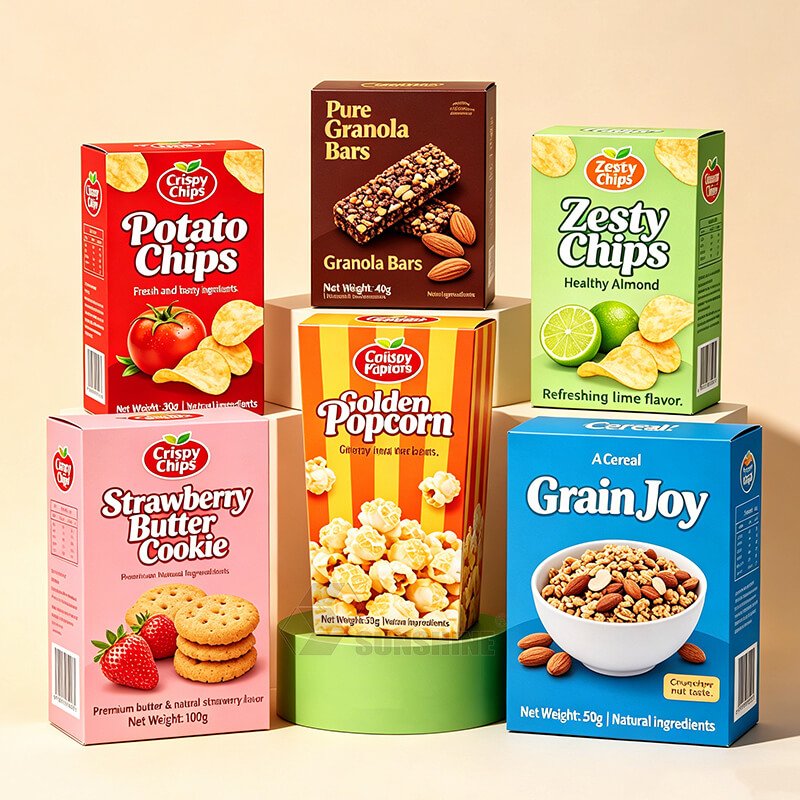
- Packaging for nuts, chips, biscuits, cookies, and nutrition bars
- Different artwork versions for multiple SKUs
- Printing and surface finishing options
- Sample development and production specification confirmation
Sunshine Packaging also maintains quality and compliance systems supported by certifications including ISO 9001, ISO 14001, FSC, FSSC, IFS, BRC, BSCI, and Sedex. The specific documentation applicable to each project can be discussed during the inquiry and quotation process.
We understand that overseas buyers need more than a supplier who can manufacture a box. They need a partner who can understand the specifications, keep production information clear, and support repeat purchasing.
If you are looking for a custom snack packaging manufacturer in China, we welcome you to share your project requirements with our team.
Request a quotation for custom snack packaging boxes.
Send us your product type, carton dimensions, estimated quantity, artwork or reference photos, and delivery destination. We will review the requirements and discuss the next steps with you.
Frequently Asked Questions
1. How can I verify whether a packaging supplier in China is a real manufacturer?
Ask for its registered company information, factory address, production videos, equipment details, and an opportunity to conduct a video factory tour or on-site visit. You can also request information about which production processes are completed in-house and which are outsourced.
2. What certifications should I look for in a Chinese food packaging manufacturer?
Relevant certifications may include ISO 9001, ISO 14001, FSC, BRCGS Packaging Materials, and applicable social compliance assessments. The right documents depend on your product, sourcing requirements, and target market. Always verify the certificate holder, scope, issuing body, and validity.
3. Should I request a sample before placing a bulk order?
Yes. A sample helps confirm the carton structure, dimensions, printing, and finishing before mass production. Make sure you understand whether the sample is a stock sample, structural prototype, or custom printed sample.
4. How do I compare quotations from different packaging manufacturers?
Compare quotations using the same specifications, including dimensions, paperboard, thickness, printing, finishing, quantity, tooling, packing, and delivery terms. A unit price without these details can be misleading.
5. Can a Chinese packaging manufacturer handle orders for multiple snack product designs?
Many manufacturers can produce different designs within one project. However, buyers should confirm the minimum quantity per design, artwork requirements, production scheduling, and whether the cartons share compatible specifications.
6. What information should I send when requesting a quotation?
Provide the product type, box dimensions, carton structure if known, material requirements, printing details, quantity per design, artwork or reference images, and delivery destination. A physical product sample or technical drawing can help clarify the requirements.
7. How can I reduce quality problems when working with a new supplier?
Agree on a detailed production specification, approve a representative sample, confirm artwork versions, and establish inspection requirements before production. Keep important changes and approvals in writing.
8. Is it better to work directly with a factory or through a trading company?
It depends on the project. A direct manufacturer may offer closer communication with production and more control over technical details. A trading company may be useful when sourcing several different packaging categories. Buyers should understand the supplier’s actual role and who takes responsibility for quality and delivery.
9. What should I check before placing repeat orders?
Confirm that the supplier retains the approved specifications and artwork, can reproduce the previous order consistently, and has a clear process for handling any changes in materials, printing, or production requirements.
10. Can Sunshine Packaging produce custom snack folding cartons for overseas buyers?
Yes. Sunshine Packaging works with international customers on customized paperboard folding cartons for snack food applications. Buyers can provide their product details, dimensions, artwork, and order quantities for evaluation and quotation.