For food brands and packaging suppliers exporting to the European Union, understanding food packaging certifications in the EU is crucial. Not only do these certifications ensure compliance with strict regulations, but they also build trust with retailers and consumers.
Here’s a summary of the most important certifications and standards for EU food packaging:
- EC 1935/2004 – General requirements for food contact materials
- EC 2023/2006 – Good Manufacturing Practices (GMP) for food contact materials
- EU-specific measures for paper and board (heavy metals, mineral oils)
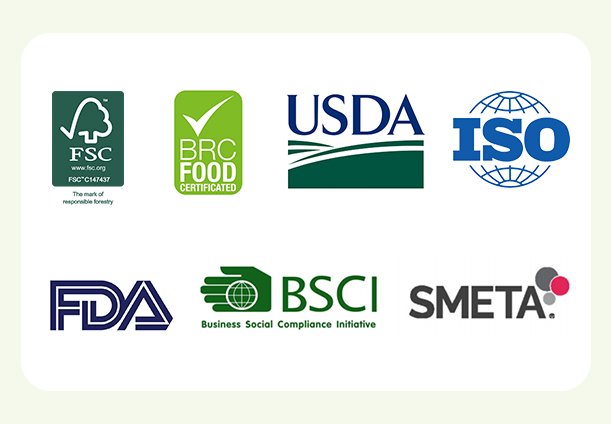
- BRC Packaging Standard – widely recognized for retail acceptance
- ISO 9001 / ISO 22000 / FSSC 22000 – quality and food safety management
- FSC / PEFC Certification – sustainability and responsible sourcing
- Compostability Certification (EN 13432) – for compostable packaging
- Other voluntary certifications: recyclable certification, Kosher/Halal, Greenguard
Some of these certifications are legally mandatory, while others are strongly recommended by retailers or consumers but not yet legally required.
Let’s break these down.
EC 1935/2004 – General Requirements for Food Contact Materials
The European regulation EC 1935/2004 is the cornerstone of EU food packaging compliance.
Key points:
- Ensures materials do not release substances that could endanger human health
- Requires that packaging does not change food composition, taste, or odor
- Manufacturers must provide Declaration of Compliance (DoC) for each material
This regulation applies to all food contact materials, including paperboard, plastics, inks, adhesives, and coatings.
EC 2023/2006 – Good Manufacturing Practices (GMP)
EC 2023/2006 specifies the good manufacturing practices (GMP) for food contact materials.
Highlights:
- Ensures materials are produced consistently and traceably
- Requires hygienic production processes to prevent contamination
- Often combined with ISO or BRC certifications to demonstrate compliance
EU-Specific Measures for Paper & Board Packaging
Paper and board packaging have additional specific EU requirements to prevent contamination:
- Heavy metals restrictions – limits on lead, cadmium, mercury, and chromium
- Mineral oil migration limits – mineral oil hydrocarbons (MOH) can migrate from recycled paper
- Compliance testing – often required for recycled fiber-based packaging
Manufacturers usually provide migration test reports to prove compliance.
BRC Packaging Standard
The BRC Packaging Standard is widely recognized by EU retailers, although not legally mandatory.
Key benefits:
- Demonstrates food safety, hygiene, and quality management
- Often requested by large supermarket chains (Tesco, Carrefour, Lidl)
- Includes traceability and audit-ready documentation
BRC certification strengthens credibility with B2B buyers and helps win contracts with retailers.
ISO and FSSC Certifications
ISO 9001 (Quality Management), ISO 22000 (Food Safety), and FSSC 22000 are not legally required, but they are increasingly expected by large retailers:
- ISO 9001 ensures consistent quality control processes
- ISO 22000 and FSSC 22000 verify food safety management systems
- These certifications help demonstrate professional and reliable production processes
Sustainability Certifications
While sustainability is not yet a legal requirement, EU buyers often expect it:
- FSC / PEFC Certification – ensures responsibly sourced paper and cardboard
- EN 13432 – for compostable packaging materials
- Recyclable certification – communicates circular economy compliance
These certifications are optional but important for retailer and consumer trust.
Other Voluntary Certifications
Some other certifications are market-driven rather than mandatory:
- Kosher / Halal – for specific target markets
- Greenguard – for indoor air quality safety
- Organic Packaging Declaration – to support EU organic labeling
These certifications can be useful if targeting premium or specialty markets, but they are not strictly required by law.
Summary
| Certification / Regulation | Mandatory | Notes |
|---|---|---|
| EC 1935/2004 | ✅ Yes | Food contact safety; DoC required |
| EC 2023/2006 (GMP) | ✅ Yes | Ensures hygienic production and traceability |
| EU Paper & Board measures | ✅ Yes | Heavy metals and mineral oil limits; migration tests required |
| BRC Packaging Standard | ❌ Optional but widely requested | Retailer-preferred food safety and hygiene standard |
| ISO 9001 / ISO 22000 / FSSC 22000 | ❌ Optional | Helps demonstrate professional management & food safety |
| FSC / PEFC | ❌ Optional | Sustainability, responsible sourcing |
| EN 13432 / Compostable Certification | ❌ Optional | For compostable packaging |
| Kosher / Halal / Organic | ❌ Optional | For specific markets |
In summary, EC regulations and paper-specific compliance are mandatory, while BRC, ISO, FSC, and other certifications are optional but strongly recommended for market acceptance.
For EU exporters, maintaining a full set of documentation, test reports, and certifications helps accelerate approval from buyers, reduce risk, and increase trust, ultimately improving conversion from inquiry to order.